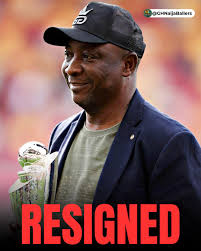
Inside Gusau'S 47-Month Reign: The Good, The Bad, And The Ugly
Posted: August 30, 2026
When the Super Eagles of Nigeria failed to qualify for the 2022 World Cup, the whole country went cold and quiet.
The atmosphere at the newly refurbished Abuja Stadium turned sour as fans went on a rampage, destroying chairs, lights, advertising boards, and seats.
The players were in tears, the pundits couldn't believe their eyes, and journalists were reluctant to report what they had just witnessed.
For the first time in sixteen years, the Super Eagles would not be at the world's greatest football fiesta. It was a night to forget for players, fans, and the entire football administration.
A few days later, Amaju Pinnick, the then NFF President, broke his silence, expressing his shock at how events had unfolded under his watch despite giving his best to the team. He described it as one of the most disappointing failures of his outgoing administration.
"I can tell you the loss is monumental. It is unquantifiable. Nigerians should forgive us and I will take responsibility as the head of the federation and apologise," he said.
While the pain was still fresh, soccer-loving Nigerians remained hopeful that the next NFF President would bring the development, structure, and vision needed to take Nigerian football back to its glory days.
They took to social media and called for a complete restructuring of the country's football governing body.
The Search for the Messiah
Given the World Cup disappointment and the poor state of the NPFL in 2022, it was obvious that Nigerian football needed a messiah. Someone bold and passionate enough to make the hard calls and take the right steps, regardless of what people thought.
Consequently, the search began as the NFF prepared for its quadrennial elective congress, which would produce the next president.
Unsurprisingly, multiple names sprang up from different corners as state FA chairmen, ex-players, and administrators all indicated interest in the position. They submitted manifestos, flaunted their CVs, and promised to fix Nigerian football within the next four years.
On 30 September 2022, votes were cast at the 78th NFF Elective Congress in Benin City, Edo State, by delegates from the 36 state FAs and the FCT chairman.
Ibrahim Gusau: The Emergence of a New Name
After a tightly contested vote, an unfamiliar name, Ibrahim Musa Gusau, emerged as the winner. He saw off challenges from Seyi Akinwunmi, Shehu Dikko, and former international goalkeeper Idah Peterside before securing 39 votes in a run-off.
Since Gusau was not a household name to many fans and journalists, doubts were raised and questions were asked.
"Is he the right man for the job? Is he the messiah Nigerians had been clamouring for? What was his pedigree and experience?" Nigerians wondered.
Well, some clues came from Amaju Pinnick, the departing president, during his farewell address at the same congress. According to him, Gusau is a strategist, a humble and innovative person.
"I see the new administration surpassing whatever we achieved because the new President is a strategist who is humble, dynamic and innovative."
Stepping into the big shoes of his predecessor and aware of the huge task ahead, Gusau was inaugurated on 11 October 2022 and set to work almost immediately. His mission was clear from the onset, and that was to return Nigerian football to its glory days.
To be fair, there were some genuine positives under his watch.
Inside Gusau's Tenure: The Good
Musa Gusagttu's tenure was not a complete failure. He can point to a number of positive results achieved along the way.
The Referees
Before his inauguration, Nigerian referees had been almost completely overlooked for continental and global assignments.
The country's last real presence in continental officiating was in 2015, when Peter Edibi served as an assistant referee at the AFCON in Equatorial Guinea.
However, we saw a significant improvement as Nigerian referees featured among the officials at the most recent FIFA U-17 World Cup and at the Women's Africa Cup of Nations in Morocco.
Recalling this achievement in his departing speech, Gusau boastfully said:
"Today, we are beginning to see the results… (of the federation’s deliberate investment in younger officials)."
Stable NPFL Schedule and Broadcasting Rights
Before Gusau's inauguration, the NPFL had no fixed calendar, starting date, or reliable structure. The 2019/20 season kicked off in August, while the 2023/24 campaign did not begin until 30 September.
The league was largely without shape until the Gusau-led NFF worked with the League Management Company to settle on a dependable calendar. The 2024/25 season kicked off on 31 August 2024 and finished, as planned, on 25 May, with Remo Stars crowned champions.
Alongside the calendar reform, the NPFL signed a broadcast rights deal with StarTimes, reported to be worth about a billion dollars over five years. For the first time in a long while, Nigerians had a dedicated channel through which to follow live NPFL matches on a consistent basis.
AFCON Silver and Bronze Medals
This is arguably the greatest achievement of the Gusau tenure. At the 2023 Africa Cup of Nations in Ivory Coast, the Super Eagles fought their way to the final for the first time since 2013, beating Cameroon 2-0 and South Africa 4-2 on penalties.
Facing hosts Ivory Coast in front of a packed crowd was never going to be easy, but the Super Eagles took the lead through captain William Troost-Ekong.
Unfortunately, Jose Peseiro's men could not hold on as they conceded two second-half goals to Franck Kessie and Sebastien Haller, as the Elephants came from behind to win 2-1.
A year later, Nigeria finished third at the 2025 edition in Morocco. Eric Chelle's men were praised for their attacking football even if it fell short of the final.
WAFCON Triumph
The Super Falcons delivered Gusau's only title of his tenure when they reclaimed the Women's Africa Cup of Nations crown after beating host nation Morocco 3-2 in Rabat.
Despite conceding twice in the first half, the Super Falcons fought their way back into the game through a second-half penalty from Esther Okoronkwo, an equaliser from Folashade Ijamilusi, and a late winner from Jennifer Echegini that completed a stunning comeback in front of a hostile home crowd.
Inside Gusau's Tenure: The Bad
Nigeria is renowned for its success at U-17 level, having won the FIFA U-17 World Cup a record five times. Unfortunately, things changed drastically for the worse under Gusau, as the Golden Eaglets missed two consecutive editions of the U-17 AFCON — and, by extension, two consecutive FIFA U-17 World Cups.
Like their junior counterparts, the Super Eagles missed a second consecutive FIFA World Cup after failing to qualify for the 2026 edition.
Despite the expansion from five to 10 African representatives, Nigeria couldn't make it to the mundial, having lost the automatic qualification slot to South Africa.
Though inter-continental playoffs gave Eric Chelle's team a second chance, they still couldn't make it after losing the African playoffs final to DR Congo on penalties.
It was another sad moment in the country's football history as the Super Eagles missed the greatest football competition for the second time in a row.
The failure wasn't limited to national teams as NPFL teams also struggled in the CAF Champions League and CAF Confederation Cup.
Enyimba International FC did not make it past the group stage in the 2024/2025 CAF Confederation Cup after a disappointing 3-1 loss to Zamalek SC.
In the 2025–26 CAF Champions League campaign, NPFL champions Remo Stars couldn't survive the second preliminary round, having lost 7-1 on aggregate to Mamelodi Sundowns of South Africa.
Inside Gusau's Tenure: The Ugly
Super Falcons set to miss the World Cup the first time
If the men's team's story under Gusau was one of near misses, the lowest point of his reign belonged to the women's game.
The Super Falcons of Nigeria, ten-time African champions, were the only team to have appeared at every edition of the FIFA Women's World Cup since its inception in 1991.
Sadly, the ladies lost their invincibility due to Gusau's poor treatment of the team. They failed to qualify for the 2027 tournament in Brazil.
The trouble began at the 2026 WAFCON in Morocco, where the defending champions lost 1-0 to Cameroon in the quarterfinal round.
The defeat pushed Nigeria into the longer inter-confederation play-off route, alongside the other three quarter-final losers.
Drawn against South Africa's Banyana Banyana for one of three remaining World Cup places, the Super Falcons needed a win to keep their hopes alive.
Instead, they lost 2-1, meaning Nigeria will be watching a Women's World Cup from home for the first time in thirty-five years.
That defeat was the straw that broke the camel's back. Head coach Justin Madugu was sacked, and the NFF set up a review committee to examine what had gone wrong.
That wasn't all!
Fund Mismanagement Scandal
The country's security and anti-corruption agencies (DSS and EFCC) began to scrutinize how the NFF handled a 17 billion naira federal intervention fund approved by President Bola Tinubu in 2024 to clear outstanding wages and bonuses owed to Nigeria's national teams and officials.
With pressure mounting from every direction, the NFF's leadership crumbled as Gusau announced his resignation on 27th August at a press conference in Abuja.
What Next for Nigeria's Football?
A complete restructuring is the only way forward for Nigeria's football. Beginning from the NFF, the right people should be elected into leadership positions.
The best coaches should be hired to handle the national teams and be given the necessary freedom and support to perform.
NFF should ensure good infrastructure, proper treatment of the national team players, and good pre-tournament preparations.
These are the only ways to take our football back to where it belongs.